







Predictive testing for female cancers (breast/ovarian cancer): BRCARE
What is BRCA?
Breast cancer risk factors include genetic and environmental factors.Among these, inherited factors related to BRCA1/2 gene mutationsare known to be among the strongest risk factors.
Hereditary breast cancer accounts for 5–10% of all breast cancers.The chance of a child inheriting a BRCA mutation from a parent who carries itis exactly 50%, regardless of sex.
Why consider BRCARE testing?
Breast cancer incidence
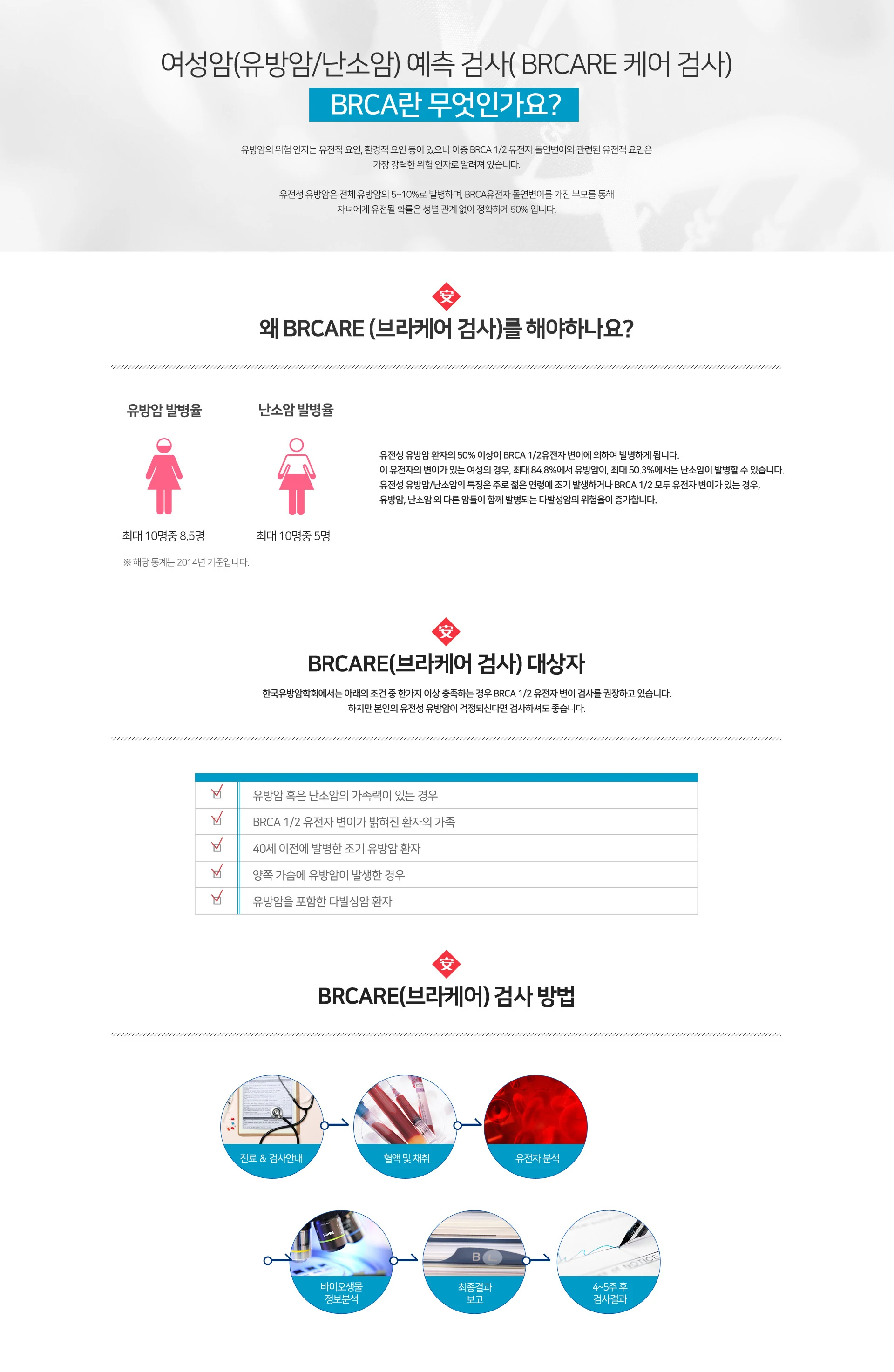
Up to 8.5 in 10
Ovarian cancer incidence
Up to 5 in 10
※ These statistics are based on data from 2014.
More than 50% of hereditary breast cancer cases develop due to BRCA1/2 gene mutations.Women carrying these gene variants may have a breast cancer risk of up to 84.8% and an ovarian cancer risk of up to 50.3%.
Hereditary breast and ovarian cancers often occur at a young age. When mutations occur in both BRCA1/2 genes, the risk of multiple cancers, including cancers other than breast and ovarian cancer, increases.
Who is BRCARE testing for?
The Korean Breast Cancer Society recommends BRCA1/2 variant testing when at least one of the following conditions applies.You may also consider testing if you are concerned about hereditary breast cancer.
- A family history of breast or ovarian cancer
- Relatives of a patient with a confirmed BRCA1/2 variant
- Breast cancer diagnosed before age 40
- Cancer in both breasts
- Multiple cancers, including breast cancer
BRCARE testing process
Consultation and test guidance
Blood sample collection
Genetic analysis
Bioinformatics analysis
Final results report
Test results after 4–5 weeks